Operation Louth - a red revolution
November 20, 2005
Acknowledging that Louth GAA has fallen into a state of crisis, Wee County chiefs have put radical plans in place to remedy the frightening and unacceptable situation. A complete new structure is being implemented, covering all bases from management, coaching and fixtures to facilities, finance and everything else in between. It's the most comprehensive overhaul in the history of Louth GAA and County Board chairman Paddy Oliver is adamant that the sweeping changes will bear fruit.
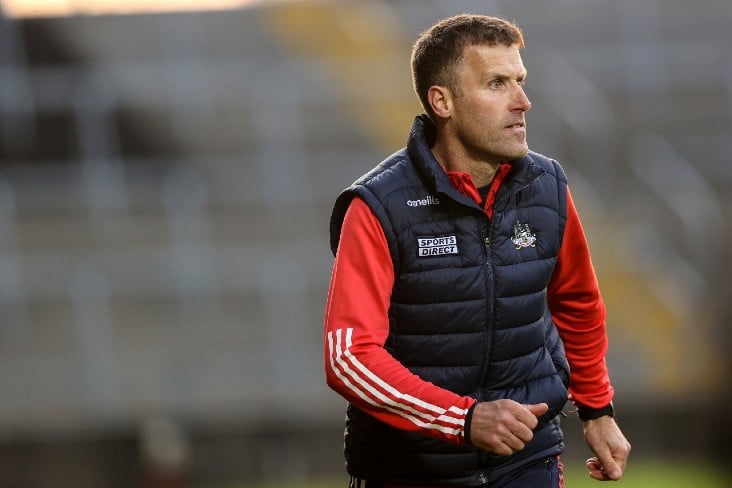
Eamonn McEneaney is not just the new Louth senior and U21 football manager. The Monaghan man is the spearhead of an ambitious new structure designed to drag Louth GAA out of the doldrums and restore pride in a county that once stood toe-to-toe with the best of the rest in Leinster and beyond. McEneaney has been granted a five-year term without review, an appointment which underlines a commitment to engineer a long-term fix.
County Board chairman Paddy Oliver acknowledges that Louth GAA was "staring into the abyss" and is urging gaels throughout the county to support the new structure, which he insists is the best - and only - way forward.
The new charter is based on the almost professional approach adopted by latter day northern giants Tyrone and Armagh, whose unprecedented dominance has highlighted the errors of Louth's hitherto fumbling-in-the-dark ways. Louth GAA found itself at a crossroads following the messy resignation of county manager Val Andrews in 2005 and the drastic action that was required has duly been delivered.
The three-man selection committee of Oliver, Michael 'Muckle' McKeown and Frank Lynch invested great thought into the process of picking a new manager and they have already sat down with the Geraldines clubman to thrash out the best plan of attack.
The manager will be allowed to get on with his job as he sees fit with no interference from executive level. He has appointed his own backroom team and has also been promised a liaison officer, coaching administrator and central training facilities. Based on the highly successful Club Tyrone, 'Cumann Louth' will aim to raise 250,000 euro per annum from the county's vibrant business community over the first five years of the new system.
Money will be spent directly on coaching structures, under the direction of a coaching administrator, who has a vital role to play in promoting gaelic games in secondary schools and Development Squads. This investment in players will be totally separated from the Darver Project and will not impinge in any way on the new facilities coming on stream there.
Every strand of the new approach will be integrated to give an infrastructure that will work if given a chance. All the pieces had to be carefully put in place, including finding the right man to manage the county senior and U21 sides. Though outsiders were foolishly expressing their discontent over the amount of time it took to appoint Andrews' successor, the selection committee were working to a clearly-defined plan - they wanted to find a manager who fits into the overall structure, understands the aims and shares their viewpoint. Eamonn McEneaney fits the bill. He has also enlisted a strong backroom team in Seamus O'Hanlon, Stephen Melia and Pat Mulligan.
Are Louth now ready to put past difficulties behind them and move forward? Paddy Oliver is forthright and honest in his assessment of the situation: "There's only one direction we can go. At the moment, we're as far down as we could go. The challenge now is to put in place the structures necessary to best rectify the situation, and that's exactly what we've done. From here on, it has to be all about making proper democratic decisions and judging issues on their merits, without any power politics or self-interest. The welfare of Louth GAA is at stake and we are meeting the challenges head-on.
"We are fully behind the new initiative. It's time to face up to our problems and move forward."
The county chairman is under no illusions as to just how far Louth football has plummeted: "We lost to Kilkenny in the minor championship and played poorly against Offaly in the Leinster championship. We stared into the abyss at home to Waterford. We then beat a Roscommon team in crisis and did fairly well against Monaghan when the players rose to the challenge.
"But, apart from victories over DIT and the Dublin U21s in the O'Byrne Cup, we have only beaten Waterford, Tipperary and Roscommon in the past two years. For Louth to struggle to beat Waterford at home in the championship simply isn't good enough. We expect to win a game like that in style."
A great deal of thought has been invested in the search for a solution: "We realised that we had to put the structures and personnel in place to bring Louth football to where we want to be. We had to find the best plan possible to move Louth football forward again. The priority was to define a system to rectify the situation. As part of this, we had to appoint a football management team whose thoughts were identical to our own. There was a real meeting of minds between incoming management and the three-man selection committee."
It was a lengthy process. Why? "We were very serious about what was needed and we wanted to appoint the best management possible. We weren't going to jump in and name a new manager inside a few weeks just to take the pressure off ourselves.
"Despite what was reported, the only two people who were interviewed outside the four nominated by the clubs [Michael Heeney, Jim Clifford, Josh Carolan and David Reilly] were Eamonn McEneaney and Pete McGrath. We spoke to Paddy Clarke about coaching structures. I know JP O'Kane from years ago but haven't seen or spoken to him recently. And I have never spoken to Mickey Linden, ever."
What really happened with Val Andrews? Paddy Oliver says the Dubliner's claims that he was about to get shafted are completely without foundation: "I spoke to him on the Monday and we agreed a time, date and venue for our two-year review, which was to take place the following Thursday. Val then resigned on the Tuesday due to his 'perceptions', which I feel were without foundation.
"I did speak to Pete McGrath and I make no apologies for doing so. I've also spoken to John O'Mahony and Mickey Harte. This was in no way undermining anybody. I was interested in talking to these people and getting their views on football matters in general. Val Andrews was left to his own devices in running the county team.
"Had he attended the review rather than walking away, an agreement was possible. If he'd sat down with us at the meeting as agreed, he'd have heard what I had to say and there would have been no 'perceptions' or innuendo - only reality
"I did not want to get rid of Val Andrews and I cannot see why he says this was the case. I don't know where he gets that idea from. At the County Board meeting the Monday after the Offaly game, I defended him and called for people not to rock the boat."
Both Eamonn McEneaney and Paddy Oliver have worked extensively with Louth Development Squad teams and they share a view that this part of Louth GAA must be nurtured and improved. As for the senior team, what results will be expected next year?
"Progress. You can't judge a man or a system on one result. We are serious about moving Louth football and hurling forward and it's important that the players realise that and respond accordingly. A quick fix is not possible. We don't want to be like Sligo, Fermanagh and Limerick who had good runs in the Qualifiers but went back again the following year. We want to make progress and consolidate. We're putting structures in place to sustain strong Louth teams. We should utilise our many strengths - there's a big population, a strong gaelic tradition and plenty of financial clout in Louth. It's a lot to work with."
Darver continues unabated: "To have a proper training base for county teams is a necessity. We need financial support from the people of Louth, both from within the GAA and business communities. But it all has to work hand in hand with the Development Squads, because we need the players coming into these grounds well-prepared."
As for the thorny issue of county grounds, the chairman promises to move forward one way or another: "We need proper county grounds and the first choice is the existing venue in Drogheda. It's important that a definite decision is made in '06 and that we reach agreement with O'Raghallaighs over the Gaelic Grounds. If that fails, we will have to grasp the nettle and provide facilities elsewhere. One of the problems in Louth is that we never have a big match in the county. When you look at our geographical location, Drogheda would be an ideal venue, but we don't have the facilities. If there are no big games taking place in the county and Louth aren't taking part in any elsewhere, juveniles will never get to see just how big the GAA actually is. So this is an issue we will address."
"Anyone who thinks there are no footballers in Louth is wrong. The players I have experienced are good enough to get results. We have an integrated system in place. With the same management, there'll be no conflict of interest between the senior and U21 teams and we're seeking that harmony across the board. We're also urging all clubs to introduce proper coaching at weekends, because good coaching and doing things properly is the way forward."
The clubs are upset, though. They're all complaining about the poor fixtures management in the county that sees each season run over into December and sometimes into the new calendar year. What's being done to tackle this? "This situation is totally unacceptable, but it's not all the County Board's fault. The clubs and the County Board have to have a unity of purpose to provide a regular club programme. We can't be calling off games for stag weekends etc.
"With 16 senior teams, 14 intermediate and seven junior, we have a pyramid system - but it's the wrong way around. The tip of the pyramid is on the ground and that's not practical. We had a good structure under Frank Lynch from 1978-88, with ten senior clubs, but it was voted out. The club structure at the moment is in a bad way. In a seven-team league, only three teams remain year on year. Action is needed."
Paddy was delighted to see the profile of hurling in the county raised substantially by the Nicky Rackard Cup run in 2005. "They had a good year. They got to Croke Park and I hope the players want to get back again and set the record straight. The hurling community in Louth is small but very dedicated. They deserve the full support of the GAA fraternity in Louth.
"With a co-ordinated approach, we could possibly increase the number of clubs to eight or ten. Mattock Rangers and St Fechins are pushing it up to six, so eight is certainly achievable."
As a man who as been deeply involved in coaching and juvenile football over the years, Paddy Oliver is an enthusiastic advocate of the Go Games concept, which he sees as "the way forward". These are a great way of developing the skills of players in the 8-12 age group and the county chairman offers his full support. "I welcome their introduction and hope people involved in juvenile football will utilise them fully. We have imposed adult structures on juveniles in the past and this is wrong. A lot of kids have had bad experiences of gaelic football and we don't want this to continue. Imagine being rejected at U10 level! We want to give everybody a chance and the Go Games will do this. I want underage coaching to dovetail into the new system."
The critical mindset and negativity have to stop. It's time for everybody to get together, united by a common cause. The structures are now in place. With the right support, Louth football can finally move forward. Onwards and upwards in the mantra.
Most Read Stories