Kilkerley's rising man in black
November 30, 2005
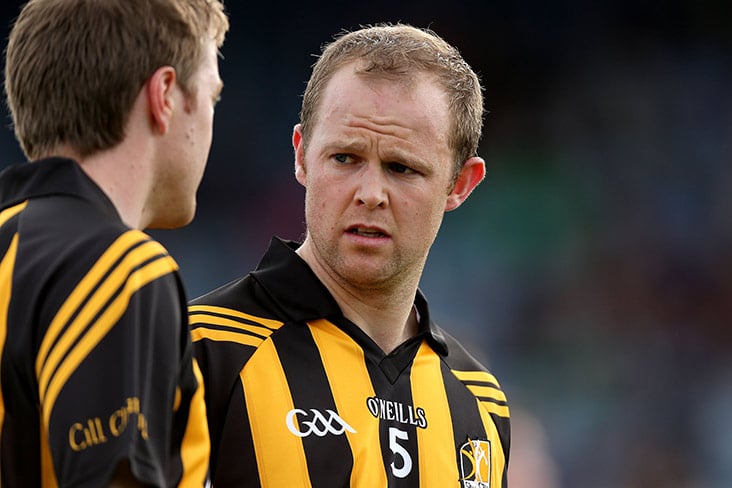
Kilkerley referee Paul Kneel has quickly established himself as one of the most respected officials in the Wee County. Though Paul was in huge demand to take charge of matches all over Louth and beyond throughout 2005, he still found time to have a chat with Gerry Robinson about his career to date in the black jersey.
As a player, Paul Kneel served Kilkerley Emmets with great distinction; he featured in two senior county finals - against Newtown Blues in 1986 and Stabannon Parnells in 1999 - but unfortunately finished on the losing side on both occasions. Regarded as a good solid club player whose commitment was never in question, Paul turned has hand to refereeing in 2001.
He has made tremendous strides during the intervening four years and is already rated as one of the best refs in Louth. Paul's practical approach to refereeing is refreshing and he appears to have the potential to go on and become one of the top officials in the country. Thus, while Kilkerley Emmets may have had a relatively disappointing year on the field of play in '05, Paul Kneel's continuing progress is definitely a cause for celebration.
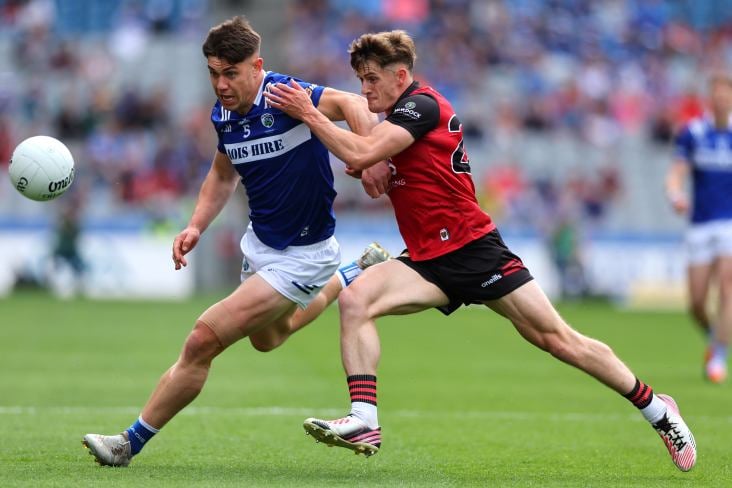
Having taken a couple of initiation sessions, Paul joined the Leinster panel in December 2004 and he made steady progress on the intercounty front during the ensuing ten months or so. He got a couple of Leinster minor league matches and also had the honour of refereeing an All-Ireland Masters quarter-final between star-studded Down and Donegal sides, both of whom were laden with All-Ireland senior winning talent and neither of whom held back on the day! DJ Kane, Ross Carr, Manus Boyle and Brian Murray were amongst the big names taking part - "They were still very competitive and the winner-takes-all mentality of Ulster football is very much in evidence even at over-40 level," the Kilkerley whistle-blower notes.
Meanwhile, Paul's star remained very much in the ascendant on the local scene. "You could be out as many nights a week as you wanted during peak season," he confirms. "There's a constant demand. There was one week in August when I was out five nights in a row at various grades from U14 up to senior."
Why is Paul being offered so many games? "I just think that if you are relatively fit and relatively new, then you will get plenty of games," he says modestly. "There is a very definite demand for new referees and you will definitely earn a lot of respect if you can stay within 20-30 yards of the play.
"At 39, I consider myself to be still in pretty good condition. I always kept fit. Even when I was playing, I went out two nights a week on my own running. I believe that if you are physically fit, you are mentally fit. I also constantly look at games through the referee's eyes, even if I'm not directly involved, and you just develop a grasp of it."
It all sounds very demanding, particularly as the work is voluntary and referees must also hold down full-time jobs. And refs never seem to get any credit. Why would anyone want to get involved in refereeing? "I was still fit and I used to go to quite a few games … I felt that I could do as good a job as most referees. I didn't stand there thinking I could do it better, because the referee is always under pressure, but I felt confident I could do as well as them. I find it enjoyable and you also feel that you're giving something back to the game."
Considering the pressure, would Paul be nervous before a big game? "I'm usually okay but there's no point telling lies - I would be nervous going out for certain games, especially a big championship match where there's a lot of tension. But you need that bit of an edge. It keeps you alert and it gives you a little bit of a buzz. Once the match starts, any nerves will disappear and you'll be focused on the task at hand."
Is the fact that Paul played at the highest level in Louth a help? Does it provide a better insight if the referee has first-hand experience of playing the game? "You know what's going through players' minds and you should have a better idea of what they're trying to do. It really helps when you know what the players are going through and you should have a feel for the game. I suppose you should also be fit too, which is a big advantage."
Paul uses the same linesmen all the time and also tries to call on the same team of umpires in so much as is possible. As refereeing is becoming more and more a team effort, this policy makes perfect sense.
Having officiated over numerous SFC matches (as well as the 2004 county minor final between Newtown Blues and Baile Talun), Paul Knell is clearly moving in the right direction. What ambitions does he have as a referee? "You like to keep developing all the time and the only way you can do this is with bigger and better games. So I'd like to do a senior final in Louth and start getting some championship games in Leinster. Everyone likes a challenge and you need to keep testing yourself."
Has Paul consciously modelled his style on any other referee(s)? "You look at the top refs and you see what their best traits are. But you can't copy them. If you are fit and can stay close to the game then you will get most calls tight. The players put a great deal of effort into each game and the very least they deserve is a referee who can stay up with play. After that, you referee with common sense."
Paul has been involved with the Kilkerley Emmets club all his life, playing every age level right up to senior ranks. He played for the county minors and was on the Kilkerley first team into his early thirties (1982-2000 approximately), before a cruciate ligament injury from a few years previously finally caught up with him.
"We played Newtown Blues in the 1986 county final but I had to go off with a knee injury after only five minutes. We got through to play Stabannon in the '99 final and were well beaten."
The 2005 SFC campaign was something of a disappointment, even though Kilkerley got off to a dream start.
The Yellow & Blues were in Group B, alongside Clan na Gael, St Josephs and Oliver Plunketts. They opened their campaign with a stunning 2-12 to 0-13 victory over the Clans at Louth village on June 5 but were subsequently pipped by group surprise packets Plunketts (2-7 to 0-8 at Ardee on June 23) and the Joes (3-8 to 2-7 in Louth on July 24).
"They played really well against the Clans and I suppose in hindsight they peaked that night and probably thought they'd get to the quarter-finals. But Oliver Plunketts proved to be the surprise team this year and the Joes always play well against Kilkerley so there was no surprise when we lost that one."
Paul believes that referees need a sense of humour and he finishes on a suitably humourous note: "I work as a revenue collector for Dundalk Town Council and after collecting the rates around town refereeing is a piece of cake. It's out of the fire into the frying pan!"
Most Read Stories