McCormick overcomes physical and mental battles to lead Antrim to brink of senior return
August 06, 2026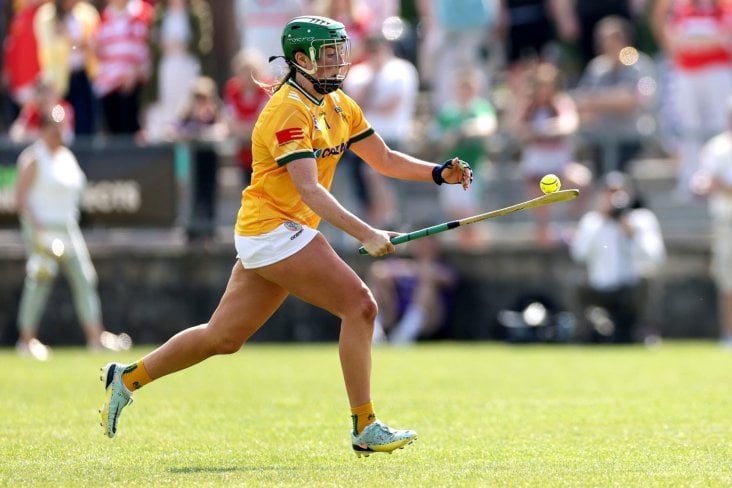
Roisin McCormick
by Daragh Ó Conchúir
These are hectic times for Roisin McCormick but the Antrim ace is hotwired for nothing less.
One of the best forwards in camogie this decade, the 25-year-old Loughgiel Shamrocks star began work as a digital marketer for the GPA in June, having gone to the Gaelic players’ representative body on placement two months previously.
Thankfully, her duties can be carried out remotely, though there is a 300 mile round trip on Wednesdays from the tip of the Glens to Dublin.
Meanwhile, she has to hand in her dissertation by the end of the month to complete her Masters. It is around elite athlete organic branding. Four of the eight subjects can be from the GAA and that will be interesting in itself, given that the concept is quite new in Gaelic games.
Before that though, there is the little matter of Sunday’s Glen Dimplex All-Ireland intermediate final against last year’s premier junior champions Laois (2pm, live on RTÉ2).
“It’s a very busy time,” McCormick admits. “I’m closing one laptop during the day to open up another one to do the dissertation. So it’s very hard to get away from the laptop. I suppose when I’m going to training, that’s nearly like a breather. I’m managing it all right at the minute. But after next weekend, it’ll lighten up quite a lot.”
Challenges come in all shapes and sizes. McCormick has long been managing playing with scoliosis, a painful condition where the spine twists and curves to the side. The knock-on impacts of that around the neck, shoulders, hips, leg muscles and feet are considerable, quite apart from the soreness of a C- or S-shaped spine.
Most people would have had surgery, with a supporting metal rod inserted, but the threat to playing camogie at the highest level meant that wasn’t going to happen.
“I was diagnosed with it around 16, and for a girl, you’re past your growing stage then. So the doctors told me if I got the surgery, that camogie’s just not going to be on the cards anymore. So, if you’re ever in the vicinity of my parents, you will understand that that was just not an option. Camogie is the be-all and end-all in this house and in this club. So I said ‘no,’ and went about my life, went about my camogie career.
“I wouldn’t even notice it straight after or during a game. It would be more like the after-effects. I would be quite sore, especially if I get a knock on the back. Or if I’m sitting in a car all day, or certain chairs I’m sitting in, I would get a sore back. It get lots of rubs and do a lot of stretching.
“There will be a time I’ll get surgery. I don’t know if that’s going to be in one year or if it’s going to be in the next five. But I need to think of quality of life beyond camogie. I suppose I need to be a wee bit smart with my decision.”
This isn’t the only challenge. One aspect of her make-up that did demand treatment was the increasingly suffocating anxiety that came with the demands she placed on herself prior to games.
“I suppose like you can look at pressure in many different ways, and it’s nearly like a privilege to feel it. Do you know what I mean? I do really look at it as a good thing. Like yeah, there’s that expectation, but it’s a great thing that there’s an expectation because people know that you have the ability to do it.
“There’s pressure externally, whether it’s friends, families, or your supporters, or media outlets. But a lot of my pressure comes internally. I beat myself up after a game if I’m not playing well, never mind scoring. That’s something that I’ve needed to learn how to cope with and how to manage. Because it was then impacting my performance more on the pitch. If I’m starting to kick myself, ‘Jesus, I haven’t gotten a ball here.’ The expectation I had of myself was nearly unrealistic at times. But then that’s why you set standards for yourself too.
“Performance-wise, your skill and performance for camogie has to be at top tier. But I don’t think people realise how much the mental skills come into it as well, and being able to carry yourself through a game, no matter how good or bad you’re playing. And that’s something I’ve needed to adapt within the last few years. It just took a few conversations.
“It started off with friends, particularly in the club championship last year. I started putting an unnecessary amount of pressure on myself. It was Amy Boyle said it to me first. I started vomiting before matches in the warm-up and I had never felt nervous for a game. But my body was reacting to the environment and I just couldn’t understand it.
“Amy saw that and said, ‘Maybe you need to speak to someone because it’s clearly your body reacting to the pressure that you’re putting on yourself or the pressure that’s on you.’ So I think it started off with Amy stepping in, and then I was able to go seek a bit of support after that, and learn how to deal with it, and then how to obviously cope with the expectation I have of myself.”
Boyle is a friend, a clubmate and a fellow product of a remarkable development structure. The pair of them were joined by Caitríona Graham, Caoimhe Conlon and Maeve Kelly on Antrim’s 2017 All-Ireland minor B championship-winning squad, as well as the Devlin twins Brónagh and Áine, who won All-Ireland medals with the county’s ladies footballers last weekend.
The following year, McCormick, Kelly, Boyle and Áine Devlin won Ulster Schools’ All-Stars. They were joined on that team by four others playing at Croke Park on Sunday – Cork powerhouse Sorcha McCartan, Armagh’s Katie Convie and Cavan duo, Shanise Fitzsimons and Niamh Keenaghan.
The Antrim contingent have a sense that they are making up for lost time. After the unstoppable McCormick/Kelly tandem propelled them to senior status by winning the 2021 intermediate title, they proved competitive at senior level, but manager Elaine Dowds was removed from her post after two years.
Most of the team walked away in protest and relegation was inevitable. McCormick’s father, Carl and Martin Coulter, steadied the ship out of a sense of duty and they won last year’s Centra Division 1B title before falling by a point to subsequent champions Offaly in the championship semi-final.
“Our lucky charm,” is how McCormick jokingly describes Dowds, who has been involved in all three of Antrim’s intermediate triumphs having won it twice as a player. She returned to the fold this season and though relegated from Division 1A of the League, Antrim took Cork’s scalp and pushed Galway to three points. But Sunday has been the one date circled in the calendar.
“I’ve been waiting for this day ever since that day we got relegated in Limerick two years ago.
“A lot went on. With Dowdsy leaving, everything was up in the air, and we could barely even field for games. No one wanted to go back after everything happening and the way things were handled. Kudos to my dad and Martin Coulter and Joey Quinn and Big Cormac (Hannon) stepping in. If they didn’t, I don’t know where the county would be right now because they were able to get players back and get a handle on things, and then last year, we won the League and we won the Ulster.
“Everything was going so well. We were on such a high, and then we just got caught out that day against Offaly. They were the better team on the day, though.”
They have learned the lessons, returning as better versions of themselves. Which makes them, and their scoring talisman, very dangerous indeed.
Tweet