Social camogie phenomenon hailed by multi-sport legend Stapleton
August 21, 2026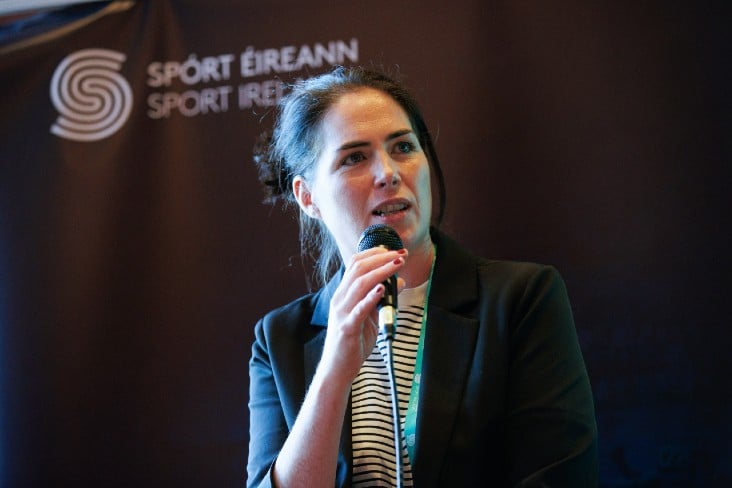
Nora Stapleton
by Daragh Ó Conchúir
Social camogie has proved a resounding success in all the key metrics: participation, inclusivity, enjoyment, providing exercise opportunities and opening up clubs to a whole new cohort of members – players, mentors, administrators and volunteers.
Nora Stapleton played at the highest level in three other codes but is relishing what social camogie provides her.
The Donegal native, who now works for Sport Ireland, has played in three rugby World Cups despite not taking up the sport until she was 24, winning two Six Nations Championships including during the historic Grand Slam campaign of 2013.
Prior to that, Stapleton helped UCD complete an FAI Women’s Cup three-in-a-row and played in the subsequent UEFA Women’s Cup campaigns.
Just a few months after making her international rugby debut in 2010, she got the better of her Ireland teammate, Niamh Briggs, as Donegal beat Waterford in an All-Ireland intermediate ladies football final.
It says something that Stapleton, who has been based in Dublin for many years now and is a member of the Ballinteer St Johns club, finds an important position for social camogie in her fitness regime.
She was introduced to camogie thanks to the passion of a school teacher
“I grew up with a hurl in my hand because of Manus O’Donnell, who would be well known in the Camogie Association because of his passion and he got us all involved,” says Stapleton.
“My first job out of college was as a CCO (club coaching officer) at Ballinteer St Johns and I coached all the codes through that including camogie.
“I did play, I think twice for Ballinteer, when they needed someone to fill in but that was all. There are a lot of challenges with the skills when the ball is coming at you or you’re trying to pick it up, or anything like it. But that’s part of the enjoyment of it now in the social camogie.”
Yes, Stapleton was an elite athlete, and staying fit remains important to her. Injuries do take their toll of course but the point of social camogie, she reminds us, is to take whatever you want from it. It caters for everyone.
There are the ex-county players who no longer had time to commit but there are those too that never held a hurley in their lives.
This is about fun, non-competitive recreation. Players must be no younger than 25. There is no maximum age. You cannot be playing competitively with another team if participating.
Teams from around the country paraded at Croke Park on Glen Dimplex All-Ireland final day on August 9. There are four provincial blitzes through the year and the social camogie year concludes with the National Social Camogie blitz, sponsored by Electric Ireland, taking place on September 12.
“I played a lot of sports at a high level and rugby was the last one and when I retired from that, you miss the team environment and being involved. Being involved in social camogie is a little bit of me practising what I preach, to be honest, because my role in Sport Ireland is trying to encourage the national governing bodies to have options for people to stay involved for their whole life. Not just you can play until your knees can’t handle it anymore!
“I didn’t have the availability in my life anymore to be competitive and not that I necessarily wanted to either.
“What I love about social camogie is it’s a group of like-minded people. Training is every Monday for the most part and if you can go, you can go. But it’s just great craic when you can go.
“I think what’s special about it is that it’s so inclusive. You would have people that played county or just a lot of camogie through their lives but are mums or have jobs that are demanding and don’t want having to be always at training and trying to stay up to everybody else’s level and be competitive.
“But every week nearly, every second week in the WhatsApp, somebody new is coming down. ‘Has anyone a spare hurl, or a spare helmet?’ There are so many beginners and that’s nearly the best thing, as they’re mastering the skills: roll lifting the ball for the first time, striking it out of the hand for the first time.
“There’s no upper age limit either. We’ve all ages. There’s people in their 60s and 70s playing as well. As I keep pointing out, it’s so inclusive. This is not for people that played and are looking for their next big moment. This is for people to come into a fitness environment, you’re running around and you’re meeting new people.”
Improving opportunities for women to socialise through sport is critical and there are social benefits beyond that.
“Mothers have a huge imprint on their kids’ social activity, in terms of how active they are, so if your kids can see you picking up your football boots, your hurl, your helmet, and you’re heading out the door, those things have a huge impact on whether or not they’re going to be.
“That should not be underestimated and it can’t be over-emphasised. You’re doing it for yourself but actually if you do have kids, that’s resonating with them as well.”
The national blitz promises to be another fantastic occasion and opportunity to broaden the scope of people and experiences.
Certainly, if the positivity surrounding the parade on All-Ireland Final day is mirrored, it will be a hit, just as social camogie has been.
“The girls had a chance of getting out on Croke Park on the day of the finals and it was a very proud moment for the club. They were absolutely delighted. The buzz was great. There were families and different club members in the stand cheering them on and it was great to be part of a record crowd at the finals.
“I would encourage every single GAA club to establish social camogie. We have a committee that does phenomenal work to keep it going, to organise blitz days ourselves, organising gear and those sorts of things. There is a bit of work there.
“But by having more social camogie teams, now the club have a whole new cohort of membership. Some of us might have been volunteers and but with playing membership, the club has increased sales of membership, sales at the club shop, use of the club bar for occasions or personally and then a lot of them are new to camogie, so that’s new families coming into the club and kids in the future.
“So there’s a full cycle in this for clubs as well as the benefits to the individuals themselves.”
Tweet