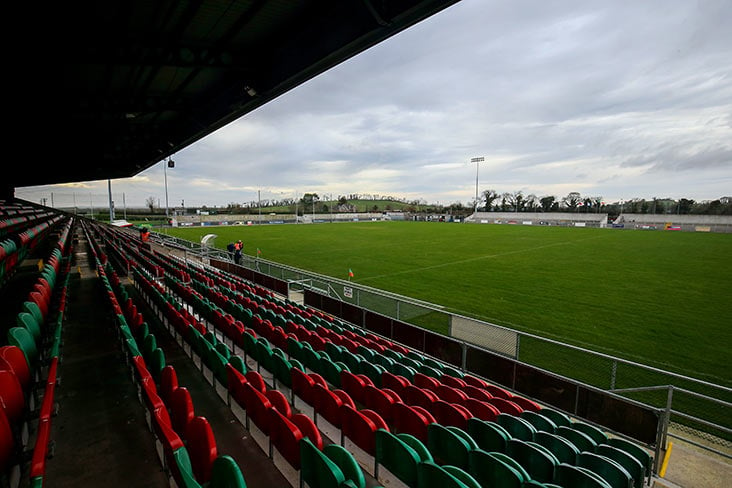
Carr drives into Cavan
March 31, 2009
Almost four years after his spell in charge of Roscommon, Tommy Carr is back in the management game with Cavan. And the former Dublin boss is a bundle of enthusiasm as he speaks to Shane Breslin about his new role.
On the face of it, it could hardly be labelled a dream job. A team preparing for life in the third tier of the National League, with hardly a championship success in recent memory to savour. A team ensconced in the most competitive province of the lot. A team in desperate need of an injection of new blood if it is to emerge from one of the bleakest periods in the county's history. It is not so much poisoned chalice, for chalice evokes a certain amount of riches; more musty old goblet, once laid out at the dining-tables of kings but lately out of sight, consigned to a box in the basement. But Tommy Carr is nothing but unbounded enthusiasm as he speaks about his return to management with Ulster outsiders Cavan.
"I can't wait to get started," Carr stated after his appointment. "Ulster is a desperately difficult province. It's probably the only totally competitive championship, in that all teams would hope to be there or thereabouts before it starts. All teams have to be at their best for the first game, as opposed to Munster, where Kerry might have to play Tipperary or Waterford. In Ulster, every team on any given day has a chance of beating any of the others.
"I suppose, if you were doing a ranking of teams in Ulster on recent form, Cavan would probably be eighth or ninth out of nine. But I spoke with two or three counties and Cavan were the ones who really impressed me with their ambition, drive and enthusiasm. They also have a great tradition, and they have a real love of football.
"We're just starting off, getting a management team in place as well as doctors, physios, kit-people, etc. I've been looking around at the players available, I've been to the county finals in Cavan. There isn't a panel at the moment to all intents and purposes, so the County Board has organised regional games. We'll get a panel together pretty quickly, then kick off with a training programme and fitness testing. There is plenty of talent in the county. I've seen a few younger players, 17- or 18-year-olds, that makes me very hopeful for the future."
The 2009 season for Carr and Cavan with McKenna Cup games on the short, sharp afternoons of January from which the Breffni County took two wins from three games. All looked rosy for Cavan heading into Division Three of the National League come February, but early defeats to Longford and Tipperary have saw them facing an uphill battle at this early stage of the season.
"I'm not sorry to be upset or overworked to get back to Division Two," Carr stressed. "That would be a great bonus but at the moment the real objective is to get the team to start believing in themselves, try to bring a certain doggedness back into the team and get them believing that there's no reason why they can't emulate a team like Fermanagh or Monaghan."
"I'm not going to sit here like Ger Loughnane and say 'We're going to win an Ulster championship in two years.' There's no point putting a noose around your own neck like that - there will be plenty to do that for you. There will be no predictions of winning titles. The first thing we want is for Cavan supporters to take delight in the team again, to be able to look down on the field and say they were proud of the team.
Niall Lynch and Peter Reilly, a member of Cavan's last Ulster Championship winning side in 1997, have come on board as selectors, and Carr is delighted to be able to call on someone as ingrained in the county's football fabric as Reilly.
"Peter is Cavan football through and through but he was sick and tired of the way football had gone in the county. He doesn't blame anybody but he'd do anything to get Cavan back up to the top shelf. He's a good judge of football and footballers, and you have to have people like that in your backroom team."
Many would have forgiven Carr if he was chastened by his experiences in Roscommon, where he spent two-and-a-half years in charge between 2002 and 2005. On the face of it, and particularly in the light of the county's fortunes since then, his time was successful, including All-Ireland quarter-final and Connacht final appearances. It ended in acrimony and recrimination in early 2005, but he insists he was not scared off intercounty management by his experiences west of the Shannon.
"I decided earlier in the year that I was getting back into management. I had done punditry and media work for a few years, and that was a very enjoyable experience, but I just wanted to get down and start working with players again.
"Roscommon didn't scare me off. Every manager knows when he's got the most out of his team and I departed on my own steam. There was a meeting and I had my letter of resignation in my pocket. Since then, they've gone through Val Daly and John Maughan. They've beaten New York but I don't think they've won a [championship] game on home soil since. It's unfortunate for them, because no more than Cavan they're real football people down in Roscommon."
Looking back to his four-year term in charge of Dublin, between 1998 and 2001, Carr admits to having one major regret: timing. He took the job at the wrong juncture.
"I could have left it a year or two after finishing playing," he concedes. "It was unfortunate. We were beaten in one or two Leinster finals, we were beaten by Maurice Fitzgerald's phenomenal point below in Thurles. Myself and Mickey Whelan came in at a time an All-Ireland-winning team was being dismantled and we were trying to start out again, so I think it was just a bit unlucky."
The latest incumbent in Dublin is Pat Gilroy, whose career in the Dublin team overlapped with Carr's to a brief extent. And Cavan's new manager is delighted that his old backroom colleague Whelan has received another chance to become part of the Dublin coaching staff.
He says: "Pat is a great fella, but in saying that no-one saw it coming and I'm not going to sit here and say I did. A lot of my contemporaries are very annoyed at how it happened, being overlooked after giving the service they did, but you can't get too personal about it.
"But I'm delighted for Mickey Whelan. He was my manager at minor level many, many years ago, and I was there the day he was booed off at Parnell Park, which I had a lot of problems with. So for him, I'm delighted. He's a great trainer, very innovative, and it's good to see him getting another shot at it."
Since his glory days as part of the Dublin team, Carr has left his capital city clubs Lucan Sarsfields and Ballymun Kickhams behind to sample the contrasting atmosphere of life in a small country club: Shandonagh, close to Mullingar in County Westmeath. And while Shandonagh have fostered a habit of near misses in the county's Intermediate Football Championship, Carr was pleased to have experienced the opposite end of the Gaelic football spectrum.
"Over the past couple of years they've been very unlucky, reaching quarter-finals or semi-finals, getting beaten by a point," he recalls. "Every year some team would come out of somewhere and clip them. But it was very enjoyable and gave me a great experience playing for a country club. In Ballymun and Lucan, things might be a bit impersonal. There isn't the same parochial effect or any real parish togetherness."
On one of those nights of board-room assassinations, when Carr was removed from the Dublin job in 2001, Dessie Farrell, the then Dublin captain, labelled him "honest, intelligent and articulate. I have never played under a more passionate and spirited manager." Those attributes, that passion and spirit, will now be brought to bear on Cavan football, as the Breffni men put one foot on the ladder and haul their way upwards.
Tommy Carr is a shareholder and managing director of Pallet Xpress, a Mullingar-based firm delivering palleted freight nationwide on a 24-hour basis. Established five years ago, Pallet Xpress employs 14 at its Mullingar hub.
PalletXpress is a network providing a superior express nationwide distribution service for palletised freight. Members are located throughout the 32 counties, and are responsible for collection and delivery within their own designated area, carrying locally-collected freight to the central hub in Mullingar each night for onward delivery by other members.
This system offers many benefits, such as enabling members to substantially reduce their operating costs, providing customers with a superior freight service, due to the high quality of members, a well-managed hub and sophisticated technology, and reducing traffic congestion and pollution, by operating at night-time and taking traffic away from Dublin-bound routes.
Most Read Stories